Brothers in Arms
On the parallels between two sidearms.
Introduction
The aim of this article is to highlight the similarities between the Webley Revolver and the Colt M1911. I can't, at this moment, explain why this is something I want written down.
Standard Issue
When one joins the army, one expects to be given a weapon, and indeed the army expects it will need to give one a weapon. Importantly, at the scale of an army it becomes necessary for that weapon to be standardised. A common design can mean bulk manufacture, standard training, and broader application of dependent systems. Furthermore, it means that the soldier's weaponry is a known quantity; An issue with one weapon may be an issue with all, and so it can be made certain that the next iteration of the design resolves that issue. Of course that isn't what I mean by 'standard issue', which instead refers to the standard weapon that one would be issued.
Many factors can determine what standard by which you are issued a weapon, and there are two weapons that we are interested in. If one were to join the British Army in 2012, one would probably be issued an L85A2. However, if one were to join the British Army in 1914 then one would probably be issued a Lee-Enfield. We are interested in neither of these weapons though. The first one we are interested in is that which one would likely be issued were one to join the British Army in 1914, as an officer. In this event, one would be issued a Webley Revolver, a revolving-cylinder handgun. The second is that which one might be issued were one to join as an officer in 1914, to the U.S. Army. In this event, one would be issued a Colt M1911, a semi-automatic handgun.
1914
By 1914 the Webley had been in service for nearly 30 years, coming into service in 1887, the same year as Queen Victoria's Golden Jubilee and with Pax Britannica well underway. By comparison, the M1911 had been in service for only 3, initiating its service in the eponymous year of 1911. At this point, though Europe was on the cusp of war, Britain was at the height of power and America was ascendant. By 1939 the official service pistol for the British military was no longer the Webley, making its official service lifespan ~50 years. However, it continued to be used up until 1963 due to shortages. The M1911 continued as standard issue until 1985 with the adoption of a new handgun, giving it an official service lifespan of ~70 years.
It was during their overlapping lifespans that the world saw the British Empire reach its greatest extent, and its subsequent recession. The same time in which the world saw America rise to be a great power. The two great wars in which they served that saw the European powers demolished and America enriched, with the locus of world power shipped across the Atlantic from the Old World to the New.
Government Issue
Though both weapons were standard issue in their respective armed forces, they both also had commercial models. Webley had the Webley WG (Webley Government,) and Colt had the Colt Government. The former was generally more powerful than its army counterpart, while the latter was essentially the same. The use of Government in the name was partially marketing, highlighting that they had passed rigorous government inspection, and relating them to their use in the military.
Morphology
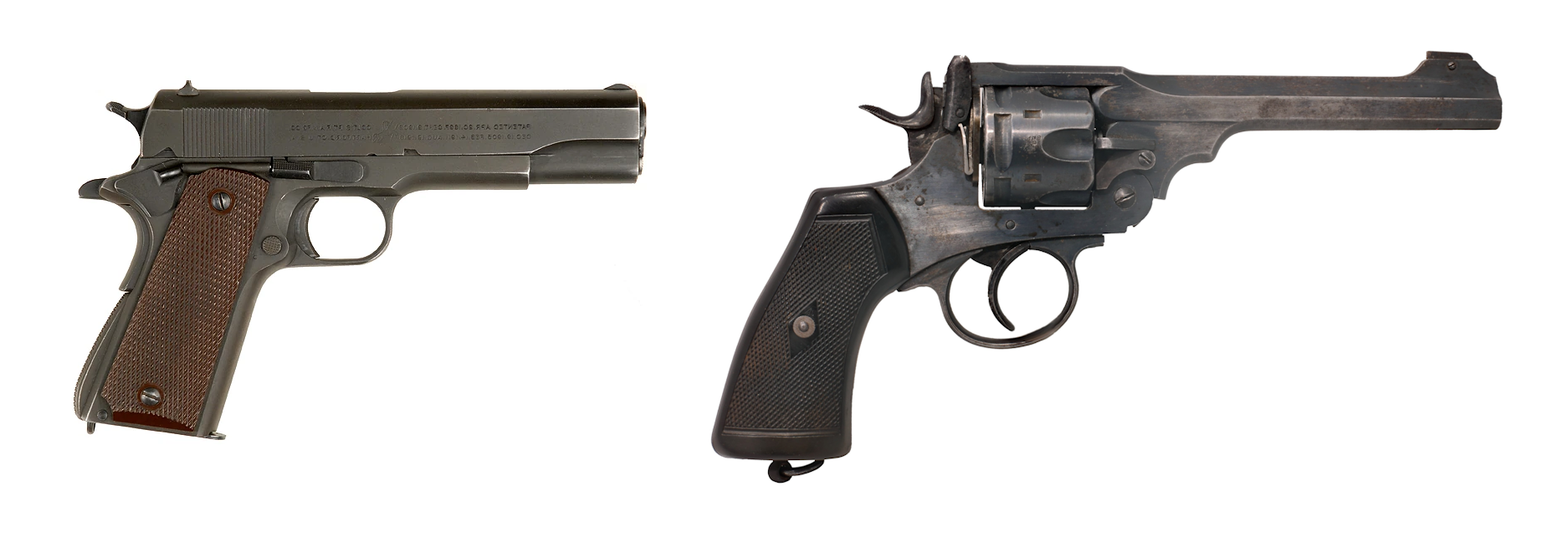
We are reaching the limits of my ability to put thoughts into words, so I'm leaning on vibes for this. The Colt (left) and the Webley (right), to me at least, have strong parallels in their appearance. It might be clearer when compared to other guns of the time, but it's potentially subjective.
Granted they are significantly different at the high-level, this is what makes the similarities more interesting. Were an American and an Englishman to travel north, they would arrive at the same place from different directions, likely never having tread the same ground.
Conclusion
Were one to chart the influence of nations, these two weapons would highlight the intersection of the U.S. and the U.K. Both arriving in a more modern world, but with one beginning to tumble over its zenith, and the other climbing to a new height. Needless to say that the U.K. and U.S. have similarities, the latter practically being born of the former, and it is interesting to see that evidenced alongside their divergences.